


Your Politics and Your Portfolio
On election night, stock futures fell on early results and grim headlines. Then they turned around.1
Depending on how you voted, that night felt like relief or dread. Surveys show Republicans tend to feel better about the economy when a Republican is in the White House, and Democrats when a Democrat is.2 After the 2016 election, a small share of investors in Republican-leaning areas made big moves into stocks, while investors in Democratic-leaning areas shifted toward safer assets.3 Neither group’s expectations tell us much about what stocks will do.
Dimensional Fund Advisors looked at stock returns from 1926 through 2025 and found no reliable pattern linking either party’s control of Congress to better or worse returns.4 Stocks rose over time under Democratic majorities, Republican majorities and split control, and they fell hard under each of them too.5 6 Returns in midterm election months looked like any other month’s.5
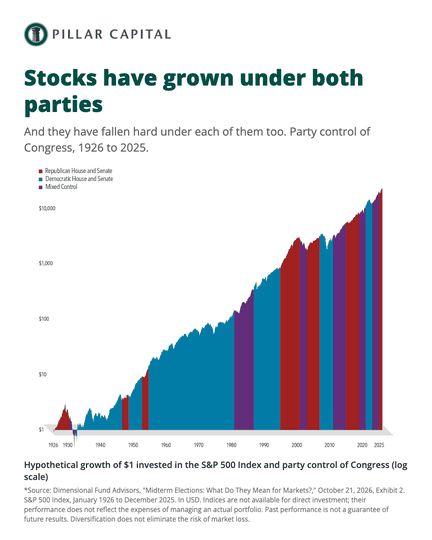
Source: Dimensional Fund Advisors, “Midterm Elections: What Do They Mean for Markets?,” October 21, 2026, Exhibit 2, hypothetical growth of $1. S&P 500 Index, January 1926 to December 2025. Indices are not available for direct investment. Past performance is not a guarantee of future results.
Markets look ahead. By the time anyone votes, prices already reflect most of what investors expect.4 What moves prices on election night is the surprise, and no one can forecast a surprise. Over longer stretches, prices answer to inflation, interest rates, economic growth, new technology and much else.4
None of this means the next few months will be calm. Some policies will change, some industries will feel it, and stocks will swing on the news. Those swings are part of the price of owning stocks, and they’ve shown up under every party.5
Where an election can matter is tax law. Congress sets what you keep when you sell a business, what it costs to trim a large stock position and what your children receive under your estate plan. Any change needs both chambers and the president’s signature, so one night’s results don’t change the rules on their own. If one of those decisions is in your next few years, reply to this email and we’ll look at the rules that apply to you.
It’s natural to care who wins. In our view, that feeling just shouldn’t be making your portfolio decisions. Vote your conscience every time, and leave your portfolio to your plan.
Sources
1. Sam Ro, CFA, “A lesson from November 2016,” TKer, November 4, 2026. https://www.tker.co/p/markets-fall-rebound-after-midterm-election-results
2. Justin Wolfers, “It’s Not the Economy. It’s Who’s Running It.,” Platypus Economics, October 21, 2026, drawing on the University of Michigan Surveys of Consumers. https://newsletter.platypuseconomics.com/p/its-not-the-economy-its-whos-running
3. Maarten Meeuwis, Jonathan A. Parker, Antoinette Schoar and Duncan I. Simester, “Belief Disagreement and Portfolio Choice,” The Journal of Finance 77, no. 6 (2022): 3191-3247; NBER Working Paper 25108. https://www.nber.org/papers/w25108
4. Isabelle Williams and Kristen Swing, “Should Politics Drive Your Portfolio Decisions?,” Dimensional Fund Advisors, November 5, 2026. https://www.dimensional.com/us-en/insights/should-politics-drive-your-portfolio-decisions
5. “Midterm Elections: What Do They Mean for Markets?,” Dimensional Fund Advisors, October 21, 2026. S&P 500 Index, January 1926 to December 2025. https://www.dimensional.com/us-en/insights/midterm-elections-what-do-they-mean-for-markets
6. “Who Controls Congress? Stocks May Not Care,” Dimensional Fund Advisors, October 23, 2026. https://www.dimensional.com/us-en/insights/who-controls-congress-stocks-may-not-care
Disclosures
Mike Johnson and Clayton Johnson are investment advisor representatives registered with Savvy Advisors, Inc. (“Savvy”). All investment advisory services offered by Mike Johnson and Clayton Johnson are offered through Savvy. Pillar Capital is an independent marketing brand name used by Mike Johnson and Clayton Johnson for advertising and marketing purposes only. Pillar Capital and Savvy are not related or affiliated. Information presented here is for informational purposes only and does not intend to make an offer or solicitation for the sale or purchase of any product or security. Be sure to first consult with a qualified financial adviser and/or tax professional before implementing any strategy discussed here. The illustration was created with AI.
Charts and data from third parties are used for illustration, and links to third-party websites are provided for reference. Savvy and Pillar Capital do not endorse and are not responsible for third-party content. Mention of any company is not a recommendation to buy or sell its securities. Indices are unmanaged and not available for direct investment, and their returns do not reflect fees or expenses. Past performance does not guarantee future results.
Indices are not available for direct investment, and their performance does not reflect the expenses of managing an actual portfolio. Past performance is not a guarantee of future results. Diversification does not eliminate the risk of market loss. This material is for educational purposes only and is not individualized investment, tax or legal advice.
Historical return data is provided for context only. It does not represent the performance of any actual portfolio and does not guarantee future results. Charts are reproduced from Dimensional Fund Advisors LP, an investment advisor registered with the Securities and Exchange Commission. Opinions of Dimensional are their own and are subject to change.
Certified Financial Planner Board of Standards Center for Financial Planning, Inc. owns and licenses the certification marks CFP®, CERTIFIED FINANCIAL PLANNER™, and CFP® (with plaque design) in the United States to Certified Financial Planner Board of Standards, Inc., which authorizes individuals who successfully complete the organization’s initial and ongoing certification requirements to use the certification marks.